rect
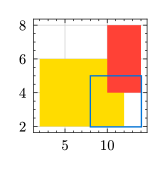
lq.rect(x, y, width: auto, height: auto, align: left + top, fill: none, stroke: auto, radius: 0pt, inset: 5pt, outset: 0pt, label: none, clip: true, z-index: 2, ..body)(source)Plots a rectangle or square with origin (x, y). The origin coordinates as well
as width and height can either be given as
- data coordinates (
intorfloat), - or absolute coordinates from the top left corner of the data area (
length), - or in percent relative to the data area (
ratio), - or a combination of the latter two (
relative).
Note that coordinate types can also be mixed (e.g., a length for x and a scalar for y).
For example in order to access the center, you can write (50%, 50%).
#lq.diagram(
  width: 3cm, height: 3cm,
  lq.rect(2, 2, width: 10, height: 4, fill: yellow),
  lq.rect(10, 4, width: 4, height: 4, fill: red),
  lq.rect(50%, 50%, width: 45%, height: 45%, stroke: blue)
)
x : float | relative | datetime
The x coordinate of the origin.
y : float | relative | datetime
The y coordinate of the origin.
width : auto | float | relative | duration default: auto
The rectangle's width.
height : auto | float | relative | duration default: auto
The rectangle's height.
align : alignment default: left + top
How to align the rectangle at the origin.
fill : none | color | gradient | tiling default: none
How to fill the rectangle.
stroke : auto | none | stroke default: auto
How to stroke the rectangle.
radius : relative default: 0pt
The corner rounding radius of the rectangle.
inset : relative | dictionary default: 5pt
How much to pad the content of the rectangle. See the built-in std.rect#inset.
outset : relative | dictionary default: 0pt
How much to expand the rectangle beyond its defined size.
See the built-in std.rect#outset.
label : content default: none
The legend label for this plot. See plot.label.
clip : bool default: true
Whether to clip the plot to the data area. See plot.clip.
z-index : int | float default: 2
Determines the position of this plot in the order of rendered diagram objects.
See plot.z-index.
..body : any
An optional body to place inside the rectangle.
